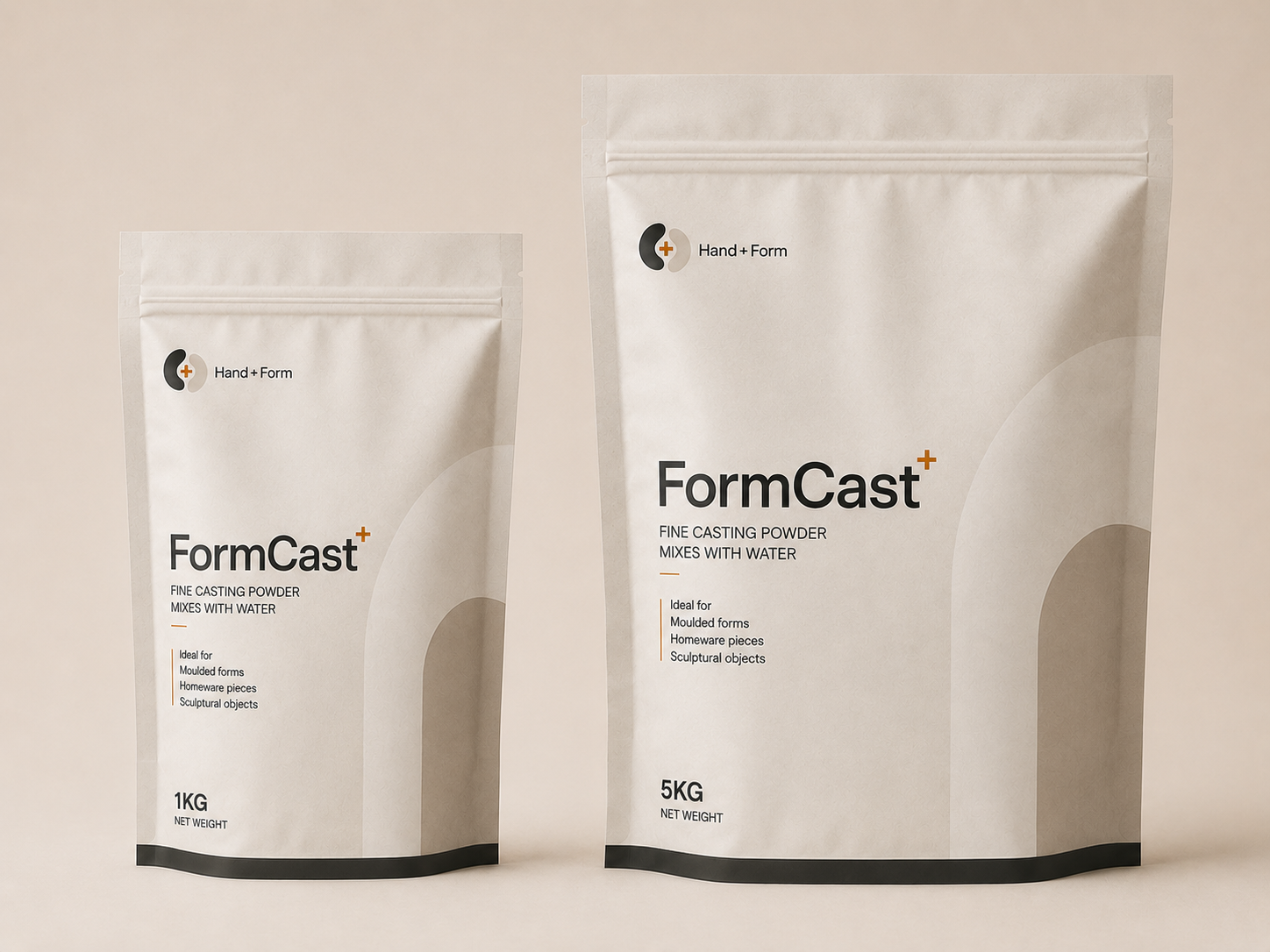
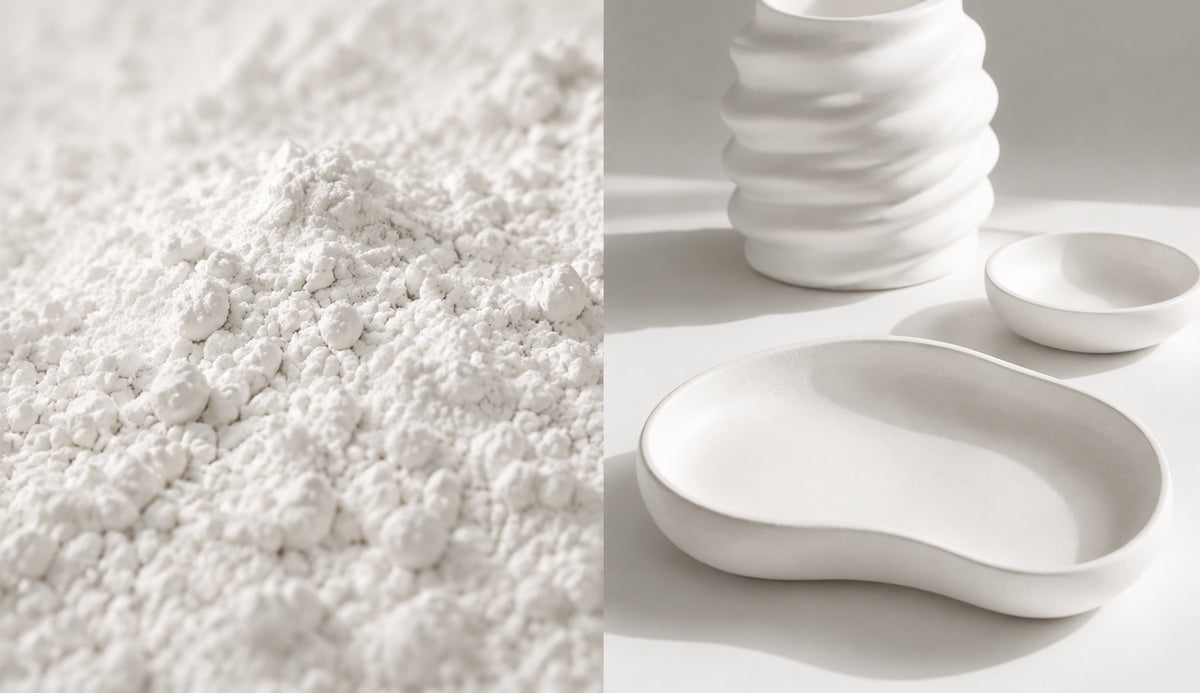
FormCast+ is a fine mineral casting material. You mix it with water, pour it into a mould, and it sets into a solid object with the shape and surface of whatever it was poured into.
That is the whole idea. There is no kiln, no workshop and no years of practice between you and a finished piece. There is a measurement, a mould, and about an afternoon.
Three things the material does
- It records a surface
- Cast against silicone and you get silicone’s smoothness. Cast against a pressed leaf and you get the leaf. The material takes on whatever it touches while liquid.
- It sets by itself
- Mixing powder with water starts the process. Nothing is heated, fired or cured under a lamp — you pour, you wait, you demould.
- It takes colour through the body
- Pigment goes into the mix rather than onto the finished piece, so the colour is the object rather than a coat on top of it.
Who it is for
It is for people who want to make a physical object and do not have a studio. A kitchen table, accurate scales and a mould are genuinely enough to start.
It is equally for people already making, who want a material that behaves predictably enough to repeat a piece twelve times and sell the twelfth.
What people make with it
The material suits objects you can hold, and objects with one clear form:
- Trays, dishes and catchalls
- Candle holders and vessels
- Decorative and sculptural objects
- Homeware — coasters, bookends, small containers
- Clock faces and lighting components
- Pressed-relief tiles and surface experiments
- Small-batch products made in repeat runs
What it is not
It is not a modelling clay. You do not shape it with your hands — you shape the mould, and the material does what the mould tells it.
It is not a craft powder for filling a rainy afternoon either. It is a material for turning an idea into something that exists.
Questions people ask
Do I need a workshop or any special equipment?
No. A protected table, accurate scales that read in grams, a mixing container, something to mix with and a mould is the whole requirement. No kiln, no oven, no extraction.
Is it suitable for a complete beginner?
Yes. The process is a sequence rather than a skill — measure, mix, pour, wait, demould. Expect the first piece to teach you something rather than to be perfect, and start with a small, open mould.
What can I cast it into?
Flexible silicone moulds are the easiest place to start, because they release without breaking the piece. You can also cast into forms you make yourself, which is where most makers end up.
How is it different from clay?
You never shape this material with your hands. You shape the mould, and the material takes the form the mould gives it. That makes repeating an object far easier than it is with clay.
